Thursday, September 17, 2009

Touchscreens are in fashion - Pure Sensia

- Pure Sensia

There have been a few new touchscreen models announced over recent weeks - with the IFA event in Berlin chosen as the launch venue.
Logitech and Revo showed off their devices there. Pure launched the Siesta Flow - but strangely seemed to hold back on the new Sensia touchscreen model - now it even has its own microsite.
Pure Sensia
The device has Internet radio, DAB and FM - and is the first model to support some of the RadioDNS protocols, in particular RadioVIS. That probably explains why the first place to have the details was Absolute Radio ... who are among the first broadcasters to support this.
This means that the radio is able to collect more information about what is being broadcast by connecting back to the Internet ... in a standard way. This could include What's On, Album artwork and potentially a click-to-buy option.

Other features of note.
  • A 5.7-inch 640x480 capacitive touchscreen (that is bigger than the fore-mentioned rivals are offering)
  • DAB, DAB+ (via future upgrade), FM and Internet Radio
  • 2 15W speakers
  • Remote control
  • Headphone socket
  • Stereo Out
  • Alarm
  • UPnP connectivity for playing media from home LAN (like the Flow models)
  • iPod connection via extra dock
  • Optional battery pack
  • Various internet apps - including Facebook (not at launch), Twitter and the weather forecast
  • Available in 4 different colours
  • Priced around 250GBP and slated for delivery in mid-October
There is also some talk of a public API coming so that 3rd-parties can develop add-ins for it.

Absolute Radio are running a contest to win some of these up until launch day - see here for more information.

So - while the radio may have the outward design of a 1960s guess at a space-age gadget ... it does have abilities that are futuristic.

There are more good looking photos over at the Pure microsite site
What Hi-Fi has a video but it looked like a fairly slowly running UI. Probably late beta code with some time left to speed things up before release.

Friday, September 04, 2009

Pure Siesta Flow

- Pure Siesta Flow
Pure used the IFA event in Berlin to officially launch their new Siesta Flow.
Word had come out a few weeks ago through a financial analyst briefing
"There will be a range of new products announced at IFA in Germany in 3 weeks - we were able to see a few in the Pure demo room but not all - we will have a new Siesta bedside radio with I-pod docker- neat- also a Siesta Flow with internet functionality".
I've been waiting for more material to arrive - and now it has ...

So - what is it?
Basically - it is a 100GBP bedside radio with internet connectivity. Using the same internet radio database as the other Flow models - Pure Lounge.

It has DAB and FM - plus can take input from external source - and can supply power out to a USB socket (e.g. to charge your phone) ... just in case you only have one power socket by the bed!


Pocket-Lint have a good photo - so I'll link to their article until Pure do their own official site update
Pocket-Lint article

Should be available soon (this year).

Thursday, September 03, 2009

Logitech finally announce Touch and Radio

- Announced for IFA

In my original posting regarding the Logitech Touch (yes - it was me that found reported the FCC report for the Touch) I suggested that the launch would be at this week's IFA in Berlin.
Looks like that is the case - as the first official info arrives on the press briefing day.

SB Touch and Radio presentation

Long-time Squeezebox fan, Radish, was a beta tester and has made a video showing off the Touch device. You can see it here (Windows Media file)

Official press release
Squeezebox Touch
Squeezebox Radio

Logitech Blog

Given that most of the information that was used to make the earlier postings had come from reliable sources (e.g. FCC test reports and mistaken publishing on Logitech sites) then it was unlikely to have much new information.
Couple of things I spotted - plus a confirmation from the Slimdevices forum:

For the Touch - a cut-down SqueezeCenter (new name coming) runs on the device so that the access music from the USB disk or SD card. This includes proper searching and providing album art not just browsing by folder ... and potentially even more useful ... it can act as a server to other Squeezeboxes (not the original Slimdevices but everything from SB2 onwards).

The Touch presents the contents of the USB/SD as a network attached drive - so you can copy files to it. This is still work in progress, since the device is not expected to ship until end of November, but beta testers report it as working.


For the Radio - the battery pack and remote are indeed optional (50 USD for the pair as an "Accessory Pack") and the six buttons around the screen are presets to store favourites.

New facility to post to Facebook (presumably all devices will get this since it will be a feature of the server software rather than the device) and see friend updates (presumably on the new full screen versions only).
Plus - a Flickr-based screensaver (clearly only applicable to the new devices with regular display screens)

Monday, August 24, 2009

Revo IKON - more promise than your average iPod dock

- Revo IKON
Announced today, for shipment in late October, is the Revo IKON.
List price is 280GBP


This looks like a good attempt at an all-in-one device - iPod dock, radio (FM, DAB/DAB+), internet radio, home media - with what should be pretty good sound for its size, combined with attractive looks and modern features (touchscreen, last.fm, album art, station info).
Inside it is using Frontier Silicon’s new multi-standard Venice 8 module.
If the implementation is a good as the device promises then this should be a winner - provided there are enough people who are willing to pay over 250GBP for something to do everything.

It includes last.fm functionality - both listening and scrobbling, although it looks like the listening part is only free for 30-day trial, which is odd given that last.fm is free for UK (and Germany plus USA) listeners. Support also claimed for Sirius, Rhapsody and Pandora - but today all of these require the listner to be in USA.

When playing your local music it will also try to show album art on the 3.5-inch touch-screen.

Feature list:
* 3.5” colour TFT touch-screen display
* High sensitivity DAB and DAB+ digital radio
* Advanced internet radio with Wi-Fi and wired LAN connection
* Easy access to over 11,000 internet radio stations (vTuner-based)
* Wirelessly stream music from your PC or MAC
* FM radio reception with RDS
* iPod docking functionality with full control and charging (folds away)
* 30 watts (2 x 15 watts) from class D amplifier
* NXT Balanced Radiator speaker technology
* Digital alarm clock with sleep and snooze
* 20 favourite station presets
* Compatible with all iPod and iPhone models
* Includes compact remote control
* 3.5mm headphone connector
* Stereo RCA line-out connectors
* Optical digital out connector

Click here for press release from Revo (PDF)
Click here for Revo image gallery

Friday, August 21, 2009

Logitech Squeezebox Radio

- Baby Boom?
Squeezebox Radio aka BabyBoom

Engadget report lead me towards another FCC test report posted today - this time it reveals a small Squeezebox with integrated speakers - a cut down Squeezebox Boom.
Squeezebox Radio - under test
It is described as:
Squeezebox Radio model X-R0001 is a compact tabletop network music player and internet radio that lets you listen to virtually any internet radio station, music service or entire personal digital music collection.
Providing remarkable sound in a compact footprint, the X-R0001 extends the power and ease-of-use of the Squeezebox to any room. The Squeezebox Radio model X-R0001 features:
• Compact Design
• Bi-amplified design with ¾-inch high-definition, soft-dome tweeter
• 3-inch high-power, long-throw woofer
• 10W digital power amplifier
• 2.4” Color TFT LCD
• Front panel controls including scroll wheel
• 802.11b/g Wi-Fi
• One-touch WPS wireless setup
• Built-in 10/100 Ethernet
• Headphone Jack
• Works with all Squeezebox family products

Something to note - looks like this is a mono device (one dome and one tweeter).
Dimensions listed as 4” x 6” x 3.25”
Although not mentioned in the summary above - the test document does refer to a battery pack - so this looks like it is a truely portable device (perhaps they will charge extra for the battery module).
Price: around 180USD

Teaming up with Queen ...
A page leaked out (and was pulled) from Logitech site stating:
"Queen

Listen to an exclusive premiere of Queen's forthcoming album, Absolute Greatest, streamed to your Squeezebox Touch or Squeezebox Radio for free until the album release in November. With Queen and Squeezebox you can: Preview Queen’s upcoming album, ..."

Here is one of the more unusual views - from underneath (showing where the product label is)

Squezebox Radio from underneath

26/Aug/2009
Updated with another picture and price
03/Sep/2009
Updated with latest inmage from Logitech (officially blogged about on their site)

Tuesday, July 28, 2009

New Sonos controller launched

- Sonos CR200
Photos have been floating around for a few weeks - but yesterday was the launch party (no - I wasn't there).
Sonos CR200

Touch screen (3.5” full-color VGA display 640x480 pixels) with some dedicated function buttons.
List price 349 USD

As always from Sonos - it looks good, it seems to works well - and it is at the top-end of the price range.
Remember - this is just a remote control for their devices - so you still need a Sonos player. Their iPhone/iPod Touch application remains free and offers very similar capability (but clearly without dedicated buttons for very quick access to some parts).

Sonos Demo
Sonos Press Release
Video from the launch party via ehomeupgrade

Tuesday, June 23, 2009

Logitech Squeezebox Touch on the way

- Squeezebox with touch screen expected by October 2009
First time I came across this was a posting back in May on, of all places, the Sonos forum. Someone (using the fourm name "walera") reported that he had been to a consumer focus event and the device was revealed as a new Squeezebox. I would have expected some form of NDA to have been in place - anyway - word was out.
Then over the last week-end some more info leaked out - including a picture.
Squeezebox Touch
It looks like a Squeezebox Classic with the VFD replaced by a 4.3" touchscreen.
But there may well be more - with reports of it also having a USB port and SD slot.
Various implications here - for example - this could allow for local storage of music and photos (show cover art when playing - and photos when idle).
There is also reported to be an infra-red presence detector that makes the screen spring back into life as you walk up to it - always fun when giving a demo.
Smaller updates also likely for the Boom and perhaps Receiver (the player half of the Duet).

Update 28/Jul/2009:
I found more details ... and have highlighted some new findings
Squeezebox Touch, model X-RC4 is countertop or wall-mounted (with included back-plate) music streaming system featuring:
• 4.3” LCD panel with capacitive touch screen
• High quality analog and headphone outputs (24bit/96k)
• Optical and coax S/PDIF outputs
• 802.11g wireless
• 64MB SDRAM & 64MB NAND flash
• SD card slot & USB host connector
• Internal speech-grade microphone and speaker – sound effects and preview
• IR sensor for remote control
• Ambient light sensor for dimming screen at night
• IR proximity sensor for detecting user approaching
• Digital temperature sensor for home automation

Interesting - perhaps there are some mistakes there ... but a microphone, small speaker and thermometer? Maybe for future expansion. Slimdevices have in the past included hardware that is not necessarily used when first released - for example infrared and headphone connector on the Squeezebox Controller.
It may well be running SqueezeOS - the same as in the Squeezebox Controller - since it gets a mention in the FCC report.

Also - an odd part number - "X-RC4". RC usually implies a Remote Control - and is nothing like the part numbers that Logitech Slimdevices folks use
(spotted so far ...
930-000074 - USA
930-000089 - Europe
930-000090 - USA/Canada
930-000091 - Aus/NZ
)

FCC test report
The implication from another document is that this is due for release by the end of September 2009 - my guess ... IFA Berlin is the launch.

Update 15-Aug-2009
It looks like Logitech web site folks made a premature release of information onto the main corporate site. It was spotted first in New Zealand and pulled soon after it was reported. However, that gave time for the details above to be confirmed.
Some more pictures as well ...

SBT in situ
SBT Memory Card
SBT Rear
SBT Front
SBT with remote

Prices:
No official word yet ... however, 3rd-party resellers are listing it around 300 USD, 400 Canadian, 450 New Zealand - implying approximately 220 - 250 Euro.
Plus there are tiny snippets visible on the Logitech site for replacement parts.
For example - a replacement power supply is 19.99 USD (same as Boom but more than Receiver) - which is the same price as a remote control (the smaller Boom remote is 9.99 USD and the bigger backlit one that ships with the Transporter is 29.99). It is not clear yet if a remote is shipped with the device although there are publicity pictures showing them together.

Update: 28/08/2009
First reported home use through a purchase rather than Logitech beta programme.
Nils' Picasa page
Forum post
Looks like a mistaken premature shipment because without a working SqueezeCenter 7.4 (being renamed SqueezeboxServer) it looks like it cannot do much.

Reciva adds native Live365 support

- Live365 from the device menu
It has been possible to play Live365 stations on Reciva devices for a long time - but with some limitations.


The stations had to be submitted to the database (or via the local My Streams) rather than being collected directly from Live365.
While "Professional" Live365 stations could be added easily enough, there had to be work-arounds to get the regular Live365 stations to work - and the VIP "Preferred" stations were more difficult again because Live365 requires the end-user to be a paying subscriber.

Other internet streaming devices, such as Logitech (ex Slimdevices) Squeezebox have had Live365 support for a long time.
Now Reciva has provided a free upgrade (initially for users of Grace Digital versions of the Reciva radios, but presumably with others to come as the brands approve it) to extend the menus to provide native access to Live365 - so that means 6,000+ more stations to try out!

Monday, April 27, 2009

Updated Pandora integration from Reciva

- First Reciva-based radio with dedicated Pandora buttons

Reciva announced their plans for official Pandora support at CES January 2008 - with a limited number of brands initially supported, the first was Grace at end of May 2008.

In April 2009 there was another related set of announcements - one was just to say that there are a few more brands with Pandora support. But I found the other more interesting ... for a couple of reasons.

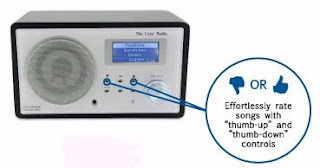
The press release says "Livio Radio’s sleek features puts Pandora® at your finger tips".
Livio radio

First there are like/dislike buttons on the device and the remote control.
Livio RemoteOK - no big thing (love/ban has been on other systems before but I think that this is the first time on a dedicated internet radio).
Second though is that Livio appears to be a sister company of Myine who recently released their Ira device which is using vTuner.
This is not the first time that a brand has gone with more than one supplier - but I don't remember anyone else having 2 suppliers so quickly.

Friday, March 20, 2009

New internet radio from Myine - ira

-

Massimo Baldini of Myine Electronics (Ferndale, Michigan, USA) replied to an email that I sent back in January to ask about this new device. The reply came recently to say that their new internet radio was nearly ready to ship ... and today an official announcement to say it is now available.

The form-factor is somewhat like a Logitech Squeezebox Classic - and like that device, it does not have its own built-in speakers.
Myine ira

So - connect up via RCA to powered speakers or hi-fi amp - set the wi-fi parameters (no Ethernet on this one) and off you go.
I think that the radio database is powered by a customised version of the vTuner system.
It comes with a remote control (and no local controls) - and has a fairly large (for this sort of device) white/blue LCD display.

Listed at 150 USD - with more details over at:
http://www.myine.com/ira.php
(the user guide is in the Help section)

Do you want everyone to know what you record?

- DABDig and Twitter
More for a bit of fun than a serious practical use, I have added some support for posting to Twitter from DABDig.
So - if you are automating your recordings
- e.g. DigiGuide -> DABDig -> Windows TV software
then you can now send info about what you are recording to your Twitter account (or in theory to other web-based services with an equally simple interface).

Maybe it will remind someone to switch to watch the same thing. I think I'll add the facility to hide shows by name though just in case people do not want some of their guilty pleasures highlighted (e.g. "Desperate Housewives" gets timeshifted here).

You can see some examples in Twitter
http://search.twitter.com/search?q=%23DABDig

I have not released this test version of DABDig yet - but if you already have a released version up and running and you have a Twitter account and fancy sharing your recording details with the rest of the Twitter-world (not the shows themselves - just info about them) then contact me (address is at the top of your dabdig.ini).

Thursday, January 15, 2009

New internet radios from Grace Digital

- New models for USA buyers from Grace include battery power and iPod dock
Before Christmas, Grace Digital said that they were going to be bringing out some new Reciva-based internet radios in early 2009.
They have now released the details and it looks like products should become available in February/March (update: one of them is not Reciva-based).

One of the radios features an iPod dock (not just an Aux-in socket). Internet radios with iPod docks are an interesting development. There are other manufacturers who have done the same thing, but it does blur the edges between internet radio, digitised music at home and personal media players.
Someone with an iPod that can handle Wi-Fi can achieve something very similar by getting a lower cost iPod speaker dock and using one of the many (free) internet radio players from Apple's AppStore.
Arguably it is not quite as easy to use - but it also brings many other functions.
However, if the person with the iPod sticks it in their pocket and goes out ... then the speaker dock becomes useless - but that is only important if there is still someone around to listen!
For people with their music collection stored on a computer - they can get to it via UPnP and other remote media streaming protocols or possibly over a shared file system and, of course, while sitting at their computer ... so they would probably not need the iPod feature of an internet radio.
Grace have neatly side-stepped the issue by making two versions available - one with and one without the iPod dock. You can pay your money and make your choice - with a 50USD difference in the models.
This option is something that some of the Pure advocates think that should have happened with the Avanti Flow.


So - what have Grace announced? In essence there is an update plus 2 completely new models, including one that is battery-powered.

The update (GDI-IR2000 and IR1000) updates the ITC-IR1000B by using what looks like the same casing and adds 5 more presets (via a new "Shift" button as seen on other Reciva-based radios), software controlled tone settings and, for the IR2000, Aux input plus a small remote control.

GDI-IR2000
To accommodate the "Shift" function within the pre-existing case layout, the buttons go through some renaming and it looks like "Browse" and "Reply" have been replaced by "Retrieve". This will confuse established Grace and Reciva users if they ever need to help newcomers via the forums.


The new models come with some variations.

The GDI-IR3000 has 2 speakers and a variation with an iPod dock (IR3020) - both available with a richer remote control (offering 99 presets).
GDI-IR3000

GDI-IR3020

The remote compounds the "Reply"/"Retrieve" confusion referred to above by adding "Recall".
No indication, as yet, of the power of the speakers, but maybe it is 2 of the old ones - i.e. 2*4.5W

The final new model is the GDI-IRP600 (presumably "P" for portable) and is their first with battery-power. GDI-IRP600
From the user guide it looks like it is not Reciva-based. The menu structure is different and is presumably using the vTuner bask-end.
There are not many battery-powered Wi-Fi radios.
One big reason being the amount of power that is drawn when trying to run a Wi-Fi connection when a long way away from a wireless access point (for example - down at the end of the garden). Plus, if you are much further away (maybe out on a picnic) you will probably not find any wi-fi to connect to!
However, by including an FM tuner, that draws a lot less power, it does mean that this becomes a portable device that should be able to be taken away from home for the day or longer.


The recent addition of support for the internet versions of the Sirius satellite content via the Reciva platform (although requiring a paid subscription to Sirius) and possibly only available to Grace radio users, will no doubt be of interest to many listeners in USA.
Sonos and Logitech/SlimDevices have had Sirius support for a while - but Grace has the potential to bring it to a new entry-level price.

More at http://www.gracedigitalaudio.com

Saturday, January 10, 2009

TEAC internet radio finally reaches the shores

- TEAC internet radio finally reaches the shores
Announced back in August 2008 was the TEAC Reference 380. A mini hi-fi with numerous components. List price around 500GBP. The tuner (T-H380DNT) - available separately for around 240GBP features FM, DAB and internet. The internet part is not mentioned very much - and I still have not seen the manual for it (it was still not on the TEAC UK site in early January). UPDATE: Manual now on-line.
TEAC T-H380DNT
The big brother system - the Reference 600 also has internet radio.

No hints about which internet radio database it is using - but since they usually source their DAB from Frontier Silicon then I presume it will be vTuner like the rest of the FS-based devices. UPDATE: Confirmed from the user manual

Nokia enters the internet radio device market

- Nokia enters the internet radio device market
Nokia has been building a database of radio stations and been heavily pushing "Comes with music" on some of its newest phones. Soon there will be a new device to take advantage of this - "Nokia Home Music".
Nokia Home Music
Features internet radio (wired and wireless), an FM tuner, analogue and digital out, analogue in, USB (to play from external disk), headphone socket - and a 3.5 inch colour display.
Looks like it has a single 10W speaker and comes with a remote control - plus can be controlled via UPnP.
It was announced in early December 2008 and should ship around March 2009.

I have not seen anything about the price yet - nor anything about which audio formats it supports.
To be a success in the UK market in particular ... it will need support for BBC Listen Again. If the work done by BBC/Nokia to get BBC iPlayer support for some of the phones has been learned from in other parts of Nokia ... then this could be a serious contender.
http://europe.nokia.com/homemusic

Thursday, November 06, 2008

New multi-function devices on the way

- New multi-function devices on the way

Both Tangent and Pure have new devices that seem to be coming out in time for, what I am sure they hope to be, a Christmas sales rush.
Both have internet radio, plus DAB and FM also with the ability to play from a USB attached disk and support for playing your own music held on the home LAN.

The new Tangent model, NET-200, is another Reciva-based radio - like their Quattro.
Tangent NET-200

This time it looks somewhat like my old Audiotron that I referred to in an earlier posting. It is a component hi-fi sized device - with no speakers. So, you add this into your existing hi-fi (including via a digital-out) or add powered speakers.
More details at the Tangent site.


Pure's second internet radio is the Avanti Flow.
Pure Avanti Flow
This does have speakers - and an iPod dock.


Both are towards the top-end of the price range for people who are simply looking for internet radio - but they do provide more than that.

Wednesday, September 03, 2008

BBC socialises radio listening

Back in May BBC showed off Olinda - a quirky internet radio prototype that tells your friends what you are listening to and allows you to tune in to what they are enjoying. People have been using Facebook, MySpace, Twitter and other sites to post updates to tell their friends what they are doing. Last.fm shows what music people are listening to - so why not have something to tell people what radio programmes they are listening to now?
Olinda
Well - I'm not sure that it is very interesting! But then I wasn't convinced by the facility in Facebook etc. Knowing that Harry has missed the bus may well be important to his employer who was expecting in on time for once or his girlfriend who faces missing the start of the film again but is it really more than a gimmick? If Twitter cannot sustain the cost of sending SMS in Europe will users pay for it?

However, I can see that aggregated information about listening habits could be useful, especially to advertisers, commissioning editors or public service broadcasters wanting their charter renewed - but I doubt that many people will switch over to listen to a programme that they had forgotten about because some of their friends are.

But - now with RadioPOP going live - http://www.radiopop.co.uk - it does mean that there will be data collected and published in full colour.
RadioPOP

Right now it is not directly linked to the popular BBC iPlayer - and only provides live streaming (not Listen Again) but it will be interesting to see how much use it gets.

At least two suppliers of the technology underlying many internet radios are based in the UK - and provide access to the BBC live and Listen Again programming. If they add support for this as well then it will give it an extra boost. However, once it gets into BBC iPlayer then the figures really will make interesting reading.

Tuesday, September 02, 2008

New internet hi-fi devices - Pure and Intempo

- Pure and Intempo with new models

All sorts of product information comes out around the time of IFA in Berlin.
The official announcement of the Squeezebox Boom that I mentioned in the previous blog entry was timed to coincide with IFA opening - and indeed shipping started on the same day.
Other products that were announced around the same time include the Intempo RFI-W and the Pure Evoke Flow.

They are both priced around the same level at the Squeezebox Boom but have a few immediately obvious differences. For example - both Pure and Intempo include regular FM radio.

Pure also include DAB (with promise of availability of future firmware upgrade to DAB+). Pure Evoke Flow
The Pure device has a single speaker and, like others in the Evoke range, can have an extra speaker added at additional cost. Another costed option is a ChargePak (rechargeable battery to you and me).
It will be interesting to see where their internet radio database comes from. The front-end to it is at http://thelounge.com but at the time of writing this it is not open. My guess is that the data comes from vTuner but I am less confident about the portal itself. Logic says that it would be a varient on that offered by Frontier-Silicon given the relationships between Pure, their parent, Imagination Technologies and Frontier-Silicon. But perhaps Pure have done their own to differentiate themselves from other brands using FS.


Intempo include an iPod dock and ability to play from SD memory card and USB disk.
Intempor RDI-W
Again it will be interesting, to me at least, to see where they are sourcing their internet radio technology from. They used Reciva for their first model, the GX-01, but a few of the early suppliers of badged internet radios are trying things with more than one manufacturer. It is due out at the end of September 2008


Logitech have put a lot of effort into the audio design of their new Squeezebox.
Logitech Squeezebox Boom

On announcement they published this great document. It contains a lot of technical detail, written in a very easy to read way - Logitech Squeezebox Boom Audio Design White Paper (PDF)
As usual, senior staff from Logitech have been active within the SlimDevices forum to answer questions about the new system. There was a private beta program running since April 2008 with some of the most active community members getting the chance to try things out and give feedback. I think that this approach is one of the big reasons why SlimDevices has both great products and passionate supporters.


It is going to be interesting to see if Logitech can steal a march on the competition by being available a full month earlier.
Will people go for what looks like more ways to listen from Pure and Intempo?
Are the audio qualities of the Squeezebox Boom going to be important?
Will the ability of the Pace device to run on an optional rechargeable battery make it more attractive to the outdoor types?
Will this new activity spur Roku into kicking new life into Soundbridge Radio?
How about Philips - I should really go and have a look at their new model to see how they have moved on since I last tried one a few years ago.

Or - will people seem them as much of a muchness and buy based on what they can find in the shops and which one has the most appealing looks and/or cheapest price?

Wednesday, August 06, 2008

Digital listening - part 3

- Digital listening - part 3

Having achieved a stable and working set-up, with local media files and internet radio playing at home, including the ability to synchronise between 2 rooms, we really had all that we needed.
However, I still wanted a bit more - internet radio in the bathroom. There were two different drivers. One was to cover the long relaxing soak in a warm bath and the other was to have news (from France) in the morning while getting ready for work. Putting electrical equipment in the bathroom is not something to undertake lightly because of the hazards of mixing power and water or steam and electronics - but trying to use the wifi-enabled PDA with wet hands or steamed-up glasses was not going to work!

So it would be used a relatively small amount of time per week and would have to be easy to operate. For the small amount of use that was expected, I could not justify putting an extra Logitech Squeezebox, plus powered speakers, in there. The user community had been calling for an all-in-1 box for quite a long time ...
Squeezebox Boom but there was no word (not even a rumour ... until on 6th August 2008 - when unofficial news of the Squeezebox Boom leaked out).

I was interested in trying out an "internet radio". One of my brothers had already seen my home set-up and wanted to do something similar. He has very poor FM reception in his bedroom and wanted to be able to listen to BBC Radio 4 last thing at night and on waking up. There were a number of potential solutions (for example - add an external FM antenna, or try and get it via longwave). In the end he bought a Logik IR100 - from memory it was about 130GBP at the time. Logik IR100

It was up and running very quickly. The built-in support for RealAudio plus Reciva maintaining an updated list of the BBC Listen Again programmes meant that it easily meet my brother's needs. (Reciva provides the engine inside the box and is the provider of the station list).
Not to be outdone ... another brother went a slightly different route - and bought the Roku Soundbridge Radio. Roku Soundbridge Radio This device also features a conventional FM and AM receiver as well as internet streaming - so looks very attractive to a radio fan.
He is pretty pleased with it but has a few usability issues plus recently the power supply failed (just after the warranty expired).

Reciva already had a few other brands using their technology - but all were priced higher than I was prepared to pay for a 3rd device ... then the Logik IR100 went through some price drops. PC World was selling them for 60GBP and eventually 50GBP. My resistance was broken one week-end as I was buying some ink and paper ... within minutes of getting it back home I was listening live to stations from around the world.
It is not wrinkle free - but more than adequate for the way we are using it.
The firmware for the Reciva-based radios is upgradable over the internet, but the process is controlled so that firmware upgrades (officially at least) are only available for particular models once the brand agrees. This does mean that there are all sorts of different versions of the firmware on different models - which can lead to some frustration when a bug fix or new facility is available to some radios but not others.
There were a few bugs that affected the Logik IR100 but the assumption was that DSG would not be interested in agreeing to an update because they were probably trying to clear the stock by dropping the price. In the end, I made contact with one of the senior members of DSG to ask if anything could be done. I had a reply pretty quickly (over a week-end) saying that it would be researched. After a few weeks there was an update to say that it looked pretty likely and then a few weeks later I had confirmation that a new firmware release would be available very soon. An excellent outcome and confirmation to me that a simple request expressed clearly, logically and without emotion ... really can work.
The Logik IR100 has moved up in price since then - but I think it is still worth looking out for good deals.

The Reciva platform has continued to spark my interest in other ways. Reciva asked if any users would be willing to help process the queue of station add/modify requests. I volunteered and was soon involved in working out the right stream URL for attempted add requests. I am not sure how many I have fixed but I expect it is well over 1000. I find it a good way to stimulate the mind in the morning before breakfast!

This is a fast moving area - so I do suggest that you do your own investigation before buying. Models that I referred to might no longer be available or issues that I had may well be resolved. Feel free to ask questions via the Comments area.

28-Aug-2008 - Updated to include official link to Squeezebox Boom

Tuesday, July 29, 2008

Digital listening - part 2

- Digital listening - part 2
Having converted some of the family to the pleasure of using a stand-alone device to play internet radio and local music files, the next step was expansion. Putting another device in an area that was not really suited to having a regular computer.
There were a few candidates that seemed to be offering something similar. They are some subtle and not so subtle differences between them (such as whether or an additional application needs to be installed, learned and run to handle core functionality, functionality of the remote control and support for many different formats/protocols for streaming - including the ability to play back material from the BBC Listen Again library).

I had seen a few at CES in 2004 and 2005 and had already been researching.

In general, I discounted devices that could not be controlled from the device (plus its remote control) itself (i.e. if it needed a TV to be on, or if the only way from from a computer).
My shortlist had come down to Sonos, Philips, RokuLabs and SlimDevices (now Logitech).

Sonos
I decided that although it looked great, it was too expensive for me and did not seem open enough for what I had in mind. Sonos
However, I have subsequently recommended it for closer inspection to friends who had both more spare cash than me and less desire to get into the technicalities.

Philips
They seemed to have the only device that really was a conventional mini hi-fi system, with CD-player, regular radio and built-in speakers but it was taking forever to come to market in Europe. Philips MC-i200
When I tried it out at CES I found the menu system too cumbersome and unresponsive - plus the internet radio function seems to only support a "walled garden" approach with no ability for me to enter my own stream URLs, plus there was no support for Microsoft WMA which would have been needed for many internet radio stations. I'm sure that either I was wrong or things have improved since then, but since I could not get my hands on one to experiment with in the UK at that time - I gave it a miss.


RokuLabs
I did like the fact that, like the Audiotron, it has a built in filesystem client so that it can play locally held music files without necessarily having to run an extra application.
RokuLabs M1000
However, it had no native support for RealAudio format - which meant that I would not have an easy way to listen to the BBC Listen Again material.
Running a connection through a local transcoding proxy could have been one way to do this - i.e. run a local server that can handle RealAudio format and have it translate the data, in real-time to something else. The loss in quality after going through such a translation could be grating, but given the relatively lo-fi that is used for most internet radio then I decided that this need not be a big issue - but I wanted to experiment.
Back then ... the RokuLabs devices included the ability to work with the then current SlimDevices SlimServer. SlimServer was (and still is - but is known as SqueezeCenter nowadays) free to download and use. So I decided to try it out since I would be able to evaluate the free software for use with either vendor.

SlimDevices (now Logitech)
As I read more about SlimDevices I was impressed with the approach they were taking.
The user forum was busy and supportive with active engagement by the manufacturer - it was clear that new functions were being added based on user requests. They seem to have put a lot of effort into the audio qualities of the box and had a good looking screen and menu system.
SlimDevices SB2 However, it did look like an old-fashioned bedside clock radio (the subsequent SB3 updated the looks, and the later Receiver plus Controller i.e. Duet goes a step further).

But, there was a free download available of a software-only emulation of the Squeezebox.
So - I downloaded the Slimserver and Softsqueeze. I had both up and running in minutes.
It was easy and extend. Softsqueeze allowed me to try out a lot of things, including putting some add-ins in place. It all worked really well.
So - I placed my order for the newly announced SB2 and it arrived direct from USA at the end of March 2005.
It proved so popular at home - that a 2nd followed not long afterwards. Sometimes we set them to synchonise playback so that we can set-up a playlist from the kitchen in the evening and then continue without a break when we eventually arrive in the bedroom.

So I had decided to go with something that seemed to have good basic functions and an active user community who were developing, with the support of the manufacturer, all sorts of interesting add-ons. I did not expect to use many of them (for example showing the scores for sports that I am not interested in) but there were some that looked promising (for example providing the BBC Listen Again content).
It could be argued that having something that seemed to require additional 3rd-party software to achieve what would lead to an overly complex solution and would need a computer to be left on to run it.
Well - I do not have a big concern over something being complex under the covers - provided there is sufficient information and support for those that are willing and able to dabble. If new functions can be added that can then seamlessly appear in the menu at the device so that everyone in the family can quickly understand how to use it if they need it then I'm all for it.
As for running a computer all of the time - although it is not strictly necessary to do this with the Squeezebox (SqueezeNetwork provides access to internet streams without need of a local server and the device also supports broadcasting a Wake-On-Lan packet to try to restart a slumbering server) ... I already run a PC all day so that it can easily generate the TV and radio listings that I upload for other users of DigiGuide (I generate programme schedule information for end-users to import into DigiGuide of over 100 stations - maybe that could be the subject of another blog entry).


Next steps
All of the manufactures featured above have released new models since I was doing my research - and there are other players in the market.
I still had an itch ... I wanted internet radio in the bathroom so that I could listen in while having a long soak. There were numerous possibilities - and apart from kicking myself for not putting some speakers in the ceiling when we had the bathroom refitted ... I was happy to start searching again. Slimdevices/Logitech were steadfastly not making any noise about producing a transportable device with built-in speakers. RokuLabs had finally shipped their SoundBridge Radio and there were other small devices that looked a bit like regular radios that could be interesting. More on this later ...

Sunday, July 27, 2008

Digital listening

- Digital listening

As DABDig, the application, has needed less of my attention over the last couple of years (partly because it already handles most of the recording possibilities with stacks of TV and radio kit - but mainly, I think, because there are much more sophisticated applications being shipped with modern computers that, for most people, obviate the desire to go and and find extra tooling such as DABDig plus the basic TV listings available in Microsoft Media Center and other similar applications mean that they are unlikely to find DigiGuide) I have spent some time getting involved with the technicalities behind internet radio - and indeed I even help run one.

I decided to post a few words about it here to see if it sparks any interest - and if it does, then I may well add more detail in the future.

How it started for me:
I have listened to radio via the internet for a long time - I don't remember when it started, but I suspect that extended hours of listening coincided with my first broadband connection at home back in 2002 (I was on the free trial being run by my cable TV company to provide broadband wirelessly, that ran for about 18 months I think - which sounds somewhat odd, but their old cable infrastructure in my area was not able to provide internet and I didn't want to have to add an extra line from a different telcoms company to get ADSL).
In January 2003 I released an update to DABDig to drive Total Recorder - so that it would be possible to schedule recording of internet radio streams from DigiGuide - because back then there was very little "Listen Again" or "On Demand" functionality on radio stations around the world.

Over the years I have had, and still have, various internet radio devices. In general, these look like regular radios or a hi-fi component (so get put in places that normal home PCs don't go - such as kitchen, dining room and bathroom) and are very easy to use for all of the family. I have taken an active technical interest in the technology and the communities built around them.
The first that I went for was the TurtleBeach Audiotron.
Sadly no longer available to buy new - but even now, some years after all support ended, it still stands up well against today's offerings.
This device can play audio files from your home computers or NAS but, via a facility called TurtleRadio, it could also play thousands of internet radio stations. This was playing most nights after we had the family dinner (music during dinner tended to be Jazz FM (when it was still just about a jazz station) or PlanetRock dependng on whose turn it was to control the DAB radio in the dining area).
After a few months of twiddling the dial to pick up different genres and countries from around the world - we ended up with a staple diet in the presets - FIP and FranceInter were always popular and remain so now, the world music station on RadioIO (RadioIO is still going but that station and compiler has long gone).

We were very happy with internet radio - and wanted (well I did anyway) to buy another one to put downstairs to augment or even replace the DAB receiver. TurtleBeach were rumoured to be making something new ... so I held off for many months to see what would arrive. In the end they announced the some updated models plus the MediaTron (same idea as the AudioTron) but could be controlled via a TV interface, including showing cover art. I was one of the few that managed to get my hands on one and have a play - on their booth at CES in Las Vegas in January 2004.

However, the device never made its way to the stores. Eventually TurtleBeach pulled the plug on the whole thing, not just the new models. So something else had to be done! I had already been researching a few other devices and had used the CES show in 2004 and 2005 to have a look at them in more detail (it was a happy co-incidence that I had to be in Las Vegas at the same time as CES for 2 years in a row).

So - what did I go for? More about that in the next blog posting.